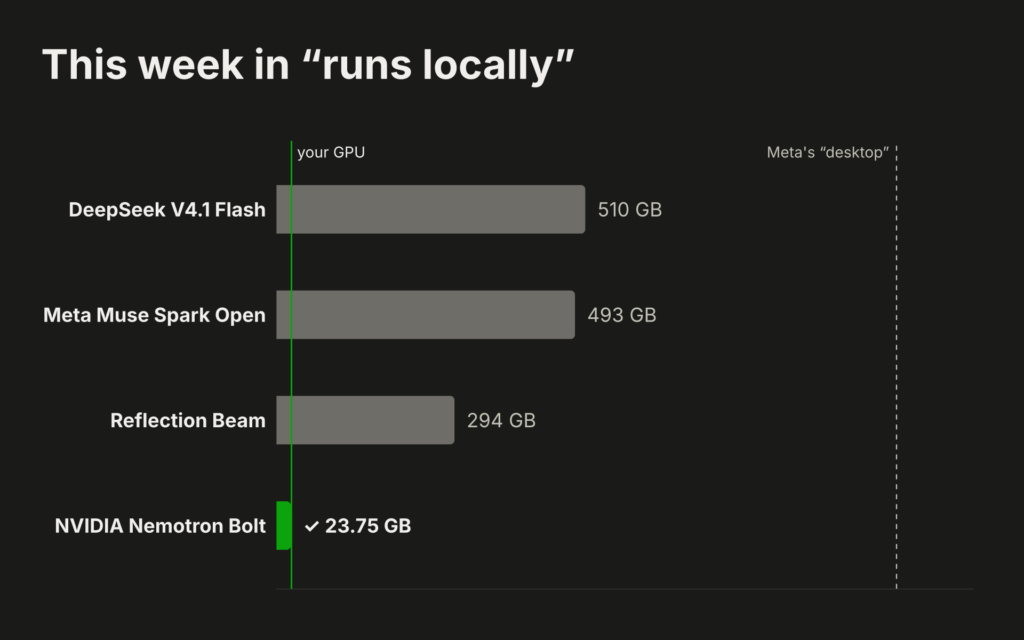
October was the month open weights became plentiful and somewhere to put them became the problem. Meta returned with Muse Spark Open, Reflection released Beam, Mistral delivered the aptly named Le Chonk, and DeepSeek and MiniMax added fresh checkpoints to the download queue. NVIDIA’s Nemotron Bolt, JetBrains’ Mellum, Recursive’s Flint, and Liquid AI’s LFM3 offered more plausible options for people whose home lab is still in their home. The distinction between open and closed remained important. The distinction between a 24GB graphics card and a terabyte of unified memory was rather easier to measure.
Hosted models became cheaper and more specialized. Haiku 5.5 and GPT-6.1 Terra pushed capable agents down the price list, Gemini Argon graduated from preview while Carbon entered restricted access, and Kimi announced another enormous model with weights scheduled for November. Around them, NVIDIA brought its AI hardware stack to Windows laptops, Microsoft described a 167kW accelerator rack, and Anthropic filed to go public while handing an agent standard to a foundation and giving external evaluators desks inside the company. Sam Altman argued that scarce RAM would get better utilization in the cloud. The internet responded by finding increasingly trivial things to do with 64GB of it.
Open weights moved in the opposite direction. DeepSeek introduced an encoder-decoder MoE with different active parameter counts for reading and writing, PrismML squeezed a 27B multimodal model into 5.9GB of ternary weights, Xiaomi published a trillion-parameter model and its reinforcement-learning stack, and H released computer-use models with their benchmark trajectories. Around them, Huawei and Alibaba described clusters measured in hundreds of thousands of accelerators, Google put Android on premium laptops and prepared a TPU for orbit, NVIDIA signed a precisely priced deal for Hugging Face, and AMD bought a model lab. September’s natural unit was no longer the billion parameter. It was the decimal point in an acquisition price.
Models
Mistral Large 4 / Le Chonk
Weight Release | Model on Hugging Face | LocalLLaMA Discussion
Mistral previewed Large 4 on October 6 and released improved weights on October 29. Le Chonk has roughly one trillion parameters, 52B active including embeddings and output layers, and a one-million-token context. It accepts text and images, was trained on European infrastructure, and ships in FP8 and NVFP4 formats. The name is unusually helpful capacity planning advice.
Mistral says three additional weeks of reinforcement learning lifted Terminal-Bench 4.0 by 13 percentage points to 41% while reducing output tokens by 30%. Those are its reported results, with three reasoning modes available to trade compute for performance. The licensing deserves as much attention as the benchmark: the Mistral Ecosystem Open-Weight License permits commercial and noncommercial use but requires a separate commercial agreement for operating a model-as-a-service business. Downloadable weights give organizations control over deployment; they do not make every business model permissionless.
NVIDIA Nemotron 3.5 Bolt and Super VL
Bolt Model Card | Super VL Announcement | Bolt Discussion | Super VL Discussion
NVIDIA released two particularly interesting local options on October 15. Nemotron 3.5 Bolt has 74B total parameters, 9B active, and a packed two-bit model of about 24GB. Its Mamba-Transformer hybrid supports text, images, video, and a 256K context, with quantization-aware training and an OpenMDW 1.1 license. NVIDIA reports 50.98 on Terminal-Bench 2.1. The small weight footprint is the attraction, although runtime buffers and the context cache still need memory of their own. A 24GB download is not a promise of 256K context on a 24GB card.
Super VL has 120B total parameters and 12B active, targeting document, chart, image, and video workflows. NVIDIA released training datasets alongside the weights and reports 80.8% on CharXiv chart reasoning, rising to 84% with Python tools. It is the larger option for adapting a model to a particular business workflow. Bolt is the one whose name is less likely to trigger a conversation about buying another computer.
Meta Muse Spark Open
Meta Announcement | Model on Hugging Face | LocalLLaMA Discussion
Meta released Muse Spark Open on October 15 with 816B total parameters, 42B active, native multimodality, and a one-million-token context. The launch spans vLLM, SGLang, MLX, llama.cpp, and Unsloth, with support across NVIDIA, AMD, Intel, and Apple hardware. After all the uncertainty about Meta’s commitment to downloadable models, an actual checkpoint is a more useful answer than another statement of intent.
The reference local configuration is also a useful reality check: two M5 Ultra Mac Studios with 512GB each, giving the system a terabyte of unified memory. That qualifies as a desktop setup in the geographical sense. The custom Muse Model License also needs checking before commercial deployment. Muse Spark Open expands the pool of frontier models organizations can host themselves; it does less for the person waiting for a new model that fits beside their game library.
Reflection Beam
Reflection Announcement | LocalLLaMA Discussion
Reflection announced Beam early in the month and released the weights on October 16. The coding model has 501B total parameters, 23B active, and an Apache 2.0 license, with BF16, FP8, and NVFP4 checkpoints plus a speculative-decoding draft model. That is a substantial release from another US lab, even if the word “local” still assumes a substantial machine.
The accompanying Mirror CLI matters beyond being another terminal interface. Reflection trained Beam together with this agent harness and published the harness as open source, including its Rust core and Python interface. For developers, the useful package is a model and an execution environment designed to work together. It also makes the performance claim more specific: changing the surrounding tools, prompts, and execution loop can change the result even when the weights stay identical. The agent has dependencies, just like the code it is trying to fix.
DeepSeek-V4.1-Flash-1017
Model and Release Notes | LocalLLaMA Discussion
DeepSeek’s October 17 release updates September’s V4.1-Flash rather than introducing another architecture. It retains the one-million-token context and MIT license, with post-training aimed at better agent execution and less time and output spent reaching an answer. DeepSeek reports Terminal-Bench 4.0 rising from 31.2 to 42.3 and DeepSWE v1.1 from 74.2 to 77.0 in its evaluation setup. Those within-release comparisons are more useful than lining up scores from different vendors’ agent harnesses.
The release also includes deepseek-recipe, a Rust library with Python bindings for converting Messages, Chat Completions, and Responses-style conversations into DeepSeek’s prompt format and parsing the result back into reasoning, tool calls, and other structured output. It does not execute tools or provide the transport layer. This is the unglamorous part of deploying open models: getting an existing agent to speak the right dialect without quietly losing information between API formats.
MiniMax M3.1 Flash
MiniMax Announcement | Model on Hugging Face | LocalLLaMA Discussion
MiniMax launched M3.1 Flash through its services on October 19 and published weights on October 23. The model has 428B total parameters, 23B active, and a one-million-token context, accepting text, images, and video while generating text. Sparse attention, quantization-aware training, and a speculative draft head all contribute to making a large model cheaper to serve. Video understanding here means watching a clip and answering about it, not generating the next clip.
The API price is $0.15 per million input tokens and $0.60 per million output tokens, with cached input at $0.015. MiniMax reports 73.7 on DeepSWE, 61.7 on OSWorld 2.0, and 62.8 on Automation-Bench. As usual, those are the vendor’s measurements. The practical appeal is the combination of inexpensive hosted access and weights that let a sufficiently equipped organization run the same model itself. “Flash” describes the serving economics more convincingly than the size of the download.
JetBrains Mellum 2.1 Thinking
Model on Hugging Face | LocalLLaMA Discussion
JetBrains released Mellum 2.1 Thinking with 12B total parameters, 2.5B active, a 131K context, and Apache 2.0 licensing. The architecture is unchanged; the substantial work happened in post-training, using real repositories, shell tools, and rewards tied to whether code passed tests. This is a compact coding model aimed at doing repository work rather than merely completing the next line.
In JetBrains’ shared evaluation pipeline, SWE-bench Verified rises from 2.0% to 47.0%, while Terminal-Bench 2.1 improves from 0.6% to 17.4%. The same table still puts Qwen3.5-9B ahead on both, so the interesting result is the improvement and deployment size rather than an invented category win. Mellum is a plausible local assistant or delegated coding worker. It is also a reminder that a familiar architecture can acquire very different practical abilities when its training starts checking whether the patch actually works.
Recursive Flint
Recursive Announcement | Model on Hugging Face | LocalLLaMA Discussion
Recursive released Flint, an Apache 2.0 coding model with roughly 40B total parameters and only 2.5B active per token. Its model card specifies a 262K context, and the company recommends staying at or below about 256K even though it describes longer configurations. Recursive reports 74.2% on SWE-bench Verified and 54.9% on Terminal-Bench 2.1, with its optimized engine exceeding 125 tokens per second on an M4 Pro MacBook Pro at short context. That last qualifier matters when comparing desktop performance.
The development story is almost as interesting as the checkpoint. Recursive says its Eureka Machine research agents contributed to the data, architecture, quantization, and inference kernels, allowing a small team to build Flint from scratch in under four months. Humans remained part of that process. It is a concrete example of agents helping build models, with a downloadable result small enough for people outside the lab to investigate.
Liquid AI d1-3B
Model on Hugging Face | LocalLLaMA Discussion
Liquid AI’s d1-3B takes a different route to low latency: it generates no output tokens at all. Built from LFM2.5-VL-3B, the 3.12B-parameter model accepts a state containing text, JSON, or images plus named questions, then returns typed answers in a single forward pass. Its 32K context is intended for decisions such as routing, moderation, reranking, and visual inspection.
Liquid reports example latencies of 8ms on an RTX 4090 and 30ms on an M5 Pro, which depend on the workload and setup. This is not a conversational replacement for a language model. It is a specialized way to answer questions such as which tool to invoke or whether an image meets a condition, without generating a paragraph and then asking another piece of software to extract the answer. Sometimes the most useful reasoning token is the one nobody has to wait for.
Liquid AI LFM3
Liquid AI Announcement | LocalLLaMA Discussion
Liquid followed on October 27 with six small models spanning text, vision, audio, omni, and decision tasks. The family starts from a 1.7B-parameter base trained on 22 trillion tokens, using a mixture of short convolutions, sliding-window attention, and global attention. The text model supports a 256K context and needs roughly 1GB for four-bit weights, before runtime and context memory are added.
Liquid says the new base outperforms LFM2.5-2.6B despite having about 35% fewer parameters, and emphasizes specialization on a single GPU. These are vendor comparisons, but the deployment target is refreshingly clear: small devices and applications that need a narrow capability at low cost. October supplied plenty of models for people with hundreds of gigabytes of spare memory. LFM3 is for the people who would prefer the assistant to share the device with the rest of their software.
Claude Haiku 5.5
Anthropic released Haiku 5.5 on October 7, bringing adjustable reasoning effort to its smallest model tier. For prompts up to 100K tokens, API pricing is $0.10 per million input tokens and $0.50 per million output tokens, with cached reads at 0.01.Above100K,thoseratesriseto 0.50 input, $2.50 output, and $0.05 cached input. The attractive headline price therefore needs a footnote in any long-context budget.
Anthropic positions Haiku for browser tasks, classification, and the smaller jobs delegated by larger agents. It reports 39.2% on Terminal-Bench 4.0 and estimates an average 75% cost reduction versus Haiku 4.5 across its measured workloads. The important change is the economics of repeated work: a model cheap enough to call throughout a workflow can be more useful than a stronger model reserved for the final answer. Just keep the prompt under the pricing threshold before celebrating the invoice.
GPT-6.1 Terra
Model Documentation | OpenAI API Changelog
OpenAI added GPT-6.1 Terra on October 26, emphasizing visual reasoning, computer use, and writing. It accepts text and images, supports a 1.05-million-token context and up to 128K output tokens, and costs $1 per million input tokens and $5 per million output tokens, with cached reads at $0.05. That puts its standard token prices at half those of GPT-6.1 Sol.
Terra offers reasoning settings from none through max and supports tool calling through the Responses API. As with the other large-context GPT models, prompts above 272K tokens increase the input and cached-input rates by 2x and the output rate by 1.5x for the request. The useful addition is another price-performance option for visual and interactive workflows. The model menu is now elaborate enough that choosing which agent should do the work is becoming a small agent task of its own.
Gemini 4 Argon and Carbon
Argon General Availability | Carbon Announcement
September’s Argon preview became a general release on October 13. Gemini 4 Argon has a one-million-token budget shared between input and output, with access through Google’s developer services and paid consumer products. Introductory API pricing is $2 per million input tokens and $10 per million output tokens through November 30, after which the published rates become $4 and $20. Cached input receives a 95% discount.
On October 28, Google announced Gemini 4 Carbon, initially limited to a subset of cybersecurity defenders in its Fairwind program. Google reports 88.2% on SEC-bench Pro and 71% on CWE-Bench, with wider availability planned later. The two releases should not be collapsed into one availability claim: developers could start deploying Argon in October, while Carbon remained gated. Google’s strongest model had barely finished leaving the waiting room before another one took its chair.
Kimi K3.1 Pro
Kimi introduced K3.1 Pro as a 3T-class model with a one-million-token context, available through Kimi’s products and API. A Highspeed variant promises two to three times the speed. The update builds on K3 with more post-training compute, targeting coding, financial research, and 3D creation; Kimi reports 65.7% on Terminal-Bench 4.0 in its published setup.
The launch also brings 3D Make, letting users preview and edit generated models online and download assets for uses including 3D printing. The availability distinction matters here: full model weights were promised by November 4, so October’s release was hosted access with an announced open-weight follow-up. Calling it a local October release would get ahead of the download. With a model in the three-trillion-parameter class, the download will have plenty of catching up to do on its own.
Hardware
NVIDIA RTX Spark Laptops
NVIDIA Announcement | Developer Overview
NVIDIA’s RTX Spark Windows laptops became available on October 16 through manufacturers including ASUS, Dell, HP, Lenovo, Microsoft, and MSI. The platform combines a Blackwell RTX GPU and Grace Arm CPU with up to 128GB of unified memory, bringing CUDA and native PyTorch support to Windows on Arm. NVIDIA quotes up to one petaflop of FP4 compute; that is a peak specification, not a universal token-generation speed.
For local-model users, the important combination is memory capacity and an established GPU software stack in a portable machine. Models such as Nemotron Bolt can run alongside development tools, and NVIDIA’s workflow demonstrations include coding, testing, and deploying from the same system. Developers still need to check their particular applications and kernels for Windows on Arm support. The laptop proposition is becoming more substantial than adding an NPU to a specification sheet and hoping someone finds a use for it.
Microsoft Maia 300
Microsoft announced plans to expand Azure Maia to multi-gigawatt deployments and previewed Maia 300 for 2027. The accelerator uses TSMC N2P compute chiplets, eight HBM4 stacks delivering 18TB/s of memory bandwidth, and a 950W thermal design point. A 96-accelerator rack is specified with 27.6TB of HBM, 1.7PB/s of aggregate memory bandwidth, and 167kW of power.
Microsoft expects 40% more tokens per megawatt than leading GPU systems and seven times the rack throughput of Maia 200. Those are forward-looking vendor claims; Maia 200 is the generation already serving production workloads. The emphasis on tokens per megawatt says as much about datacenter constraints as it does about chip design. Consumer model discussions end with whether the weights fit in memory. At this scale, the next question is whether the building has enough electricity
Other
Sam Altman, Cheeky Pint, and Your RAM
Interview and Transcript | Hello, World! Reaction
Sam Altman joined Stripe cofounder John Collison on Cheeky Pint on October 29, discussing agent swarms, AI research, and robots helping build future datacenters. The passage that escaped the podcast concerned local inference. Altman called it “quite terrible” from a global allocation perspective to distribute scarce DRAM among personal computers where, in his example, it gets used only 5% of the time. He argued that pooling memory in the cloud would maximize utilization while supply remained constrained. The 5% figure was part of his argument, not a published measurement of every reader’s PC.
For local-model users, utilization is only part of the calculation: privacy, offline access, and control over the machine also have value. The reaction turned that disagreement into jokes about hoarding RAM and deliberately spending 64GB on Hello, World! or RollerCoaster Tycoon. Altman’s argument concerned resource allocation; the memes supplied the confiscation squad. After a month of checking whether new models would fit in your computer, the internet had found a more entertaining question: whether Sam approved of what was already in it.
Anthropic Files for an IPO
Anthropic announced on October 26 that it had filed an S-1 registration statement for a proposed initial public offering, with plans to list on Nasdaq under ANT. The number of shares and price range had not been determined. A filing begins the public offering process; it is not a completed IPO or a newly established market valuation.
For a company whose releases have increasingly involved infrastructure commitments and trusted-access programs, public-market reporting would add another kind of disclosure. Model cards explain what the system can do. Securities filings explain what the business needs to keep doing it. October supplied both kinds of reading material.
Agent Skills Moves to the Agentic AI Foundation
Anthropic donated Agent Skills to the Linux Foundation’s Agentic AI Foundation on October 22, including the project’s name, logo, GitHub organization, and domain. The format packages instructions in a folder around a SKILL.md file, with supporting scripts and references when needed. Anthropic says more than 70 platforms support it and reports one million published skills and nearly 280 million installations.
The useful idea is portable procedural knowledge: the steps, examples, and resources an agent needs for a particular task can travel between tools. Foundation ownership gives multiple implementers a common place to evolve that format, following the earlier transfer of MCP. It does not make every runtime execute a skill identically, but it reduces the amount of organizational knowledge trapped inside one vendor’s prompt box. A folder of instructions is becoming an interoperability standard. Sometimes the boring format wins.
METR Gets Desks Inside Anthropic
Anthropic expanded its independent-evaluator program on October 15, including an embedded arrangement for six METR researchers with employee-like access to hardware, offices, and internal tools. The goal is to let evaluators study how models are developed and used inside the lab, beyond what an external API alone reveals.
METR can publish its findings without Anthropic vetoing the conclusions, but the agreement includes predefined exclusions and Anthropic-controlled redactions for categories such as confidential intellectual property. That boundary matters when assessing how independent and complete the resulting reports can be. Even with it, deeper access creates the possibility of evaluating the actual development process and internal agent deployments. An evaluator sitting next to the systems being studied can ask questions that a public benchmark endpoint cannot answer.
Fun